
Patrick Property Tax Records at a Glance
Patrick County property tax records split the assessment from the bill. The Commissioner of Revenue maintains the real-estate assessment function and says the county uses documents recorded with the Clerk as of January 1. The Treasurer issues and collects bills. A parcel map can help identify the land, but neither the map nor the assessment page is a substitute for a bill balance. No public static tax-bill lookup form was located in the research.
| Record or field | What it answers | Patrick office |
|---|---|---|
| Land-book description and tax-map number | Which parcel is assessed | Commissioner of Revenue |
| Owner name and address | Assessment owner information described in the county card specification | Commissioner of Revenue |
| Land and improvement values | How the taxable real estate is valued | Commissioner of Revenue |
| Bill number, charges, receipt | What was billed, paid, or remains due | Treasurer |
| Tax rate | Rate applied to taxable assessed value | County and Town rate schedules |
That means Patrick property tax records read best in pairs. The assessment gives the value and parcel context. The bill gives the charge and payment status. A change in assessed value alone does not settle the final amount, because the governing tax rate and any relief also shift what is due.
Patrick’s 2021 Baseline Meets 2027
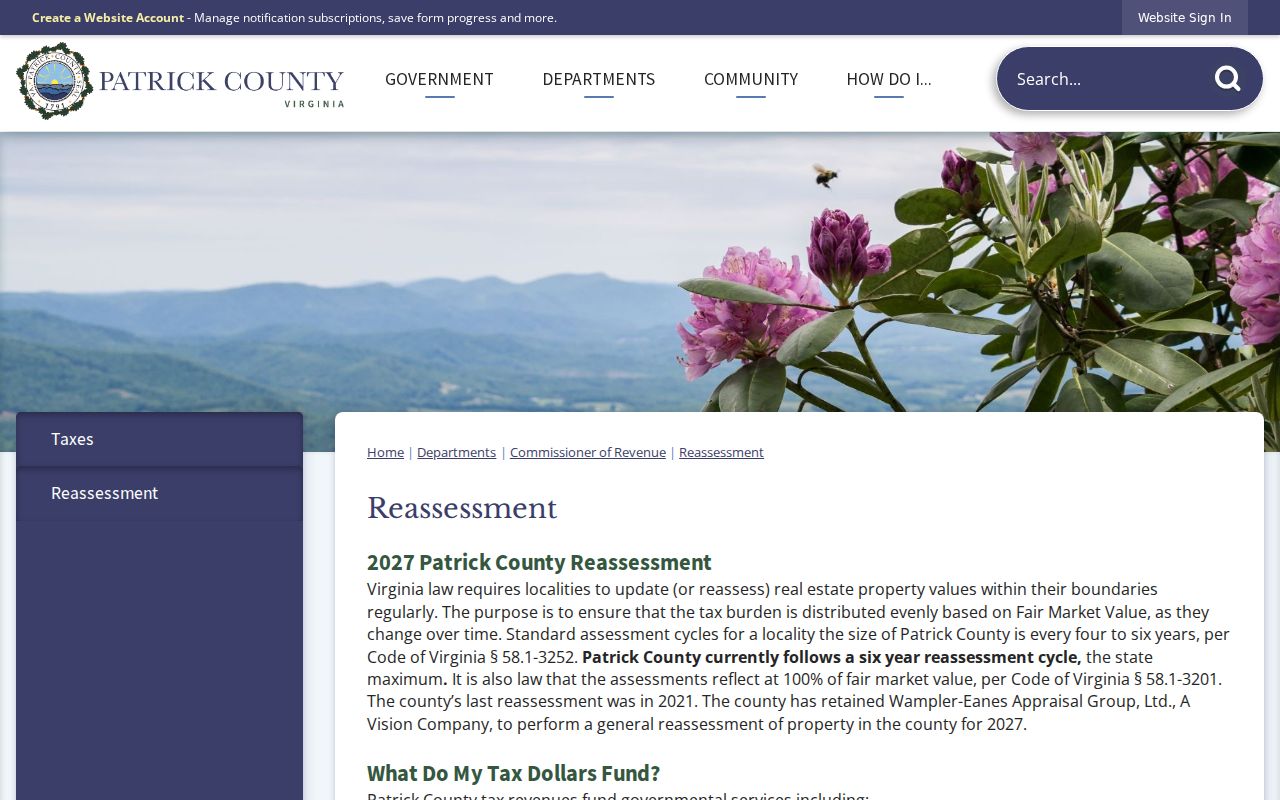
The last completed general reassessment took effect January 1, 2021. Patrick County runs these on a six-year cycle. Vision/Wampler-Eanes Appraisal Group has been hired for the next round. Field work began in July 2025, and completion is planned by December 31, 2026. Notices should reach owners in fall 2026. The new values take effect January 1, 2027. Virginia law requires assessments at 100 percent of fair market value. The Commissioner notes this applies to both land and buildings.
The 2021 roll is a baseline, not a promise. No one can assume every parcel will move by the same percentage in 2027. The county's reassessment relies on a sales study and a property review. It also values land and buildings separately. A reassessment notice will arrive eventually. Check its parcel description and acreage first. Match them against the property you care about before judging the number.
The procurement described roughly 20,500 taxable parcels, 1,100 nontaxable parcels, and about 2,000 manufactured homes. Those figures describe countywide scope. They are not counts for Stuart or one road area. Check the Patrick County reassessment page for the schedule.
Patrick Tax Rates Use Value per Hundred
Patrick County publishes a real-estate rate of $0.73 per $100 of fair market value. Stuart sets its own town rate, $0.172 per $100. The town rate applies only inside the incorporated boundary. A Stuart mailing address does not prove the parcel sits within town limits. Before calculating anything, confirm the parcel's location and the current rate on the official tax schedule.
For a county-only estimate, divide the taxable assessed value by 100 and multiply by $0.73. That covers the county real-estate tax alone. Relief and penalties are separate lines. A Stuart parcel may also owe the town rate. No rate table shows whether a bill was paid or whether the owner qualifies for relief.
An assessment is not an appraisal. It is not a guaranteed sale price either. The county's standard still values land and buildings at 100 percent of fair market value. Taxable value, rate, and the final bill are three different numbers in one calculation. Current figures appear on the Patrick County taxes page; use the published table for the year you need.
Patrick Real Estate Bills Come Due Twice
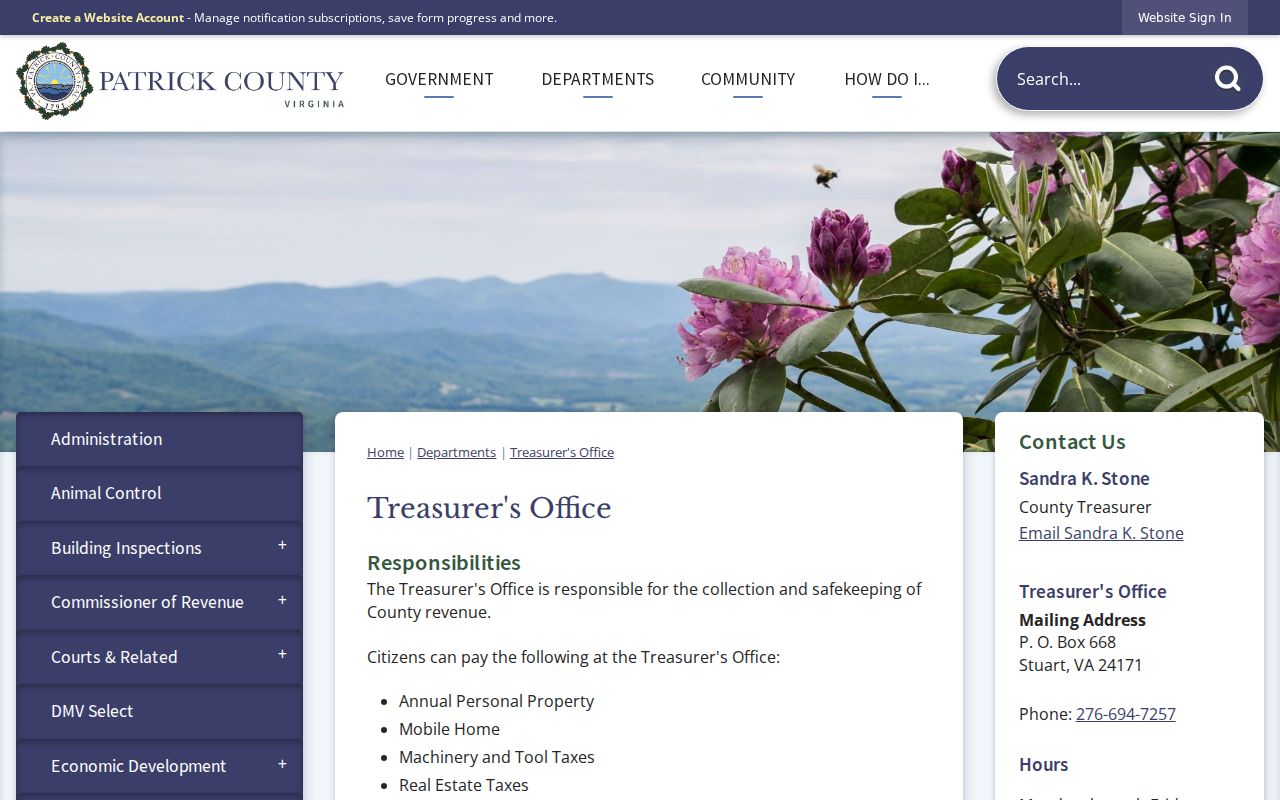
Real-estate bills in Patrick County come due twice a year. The Treasurer's FAQ sets June 5 and December 5 as the installment dates. Reminder notices are not mailed, so mark the dates yourself. A due date can land on a weekend. Payment is accepted the following Monday without penalty. An unpaid half draws a 10 percent penalty after its due date. Interest of 10 percent annually starts 26 days later. Near a due date, confirm the calendar and any special notice on the official page.
The Treasurer takes payment several ways: by mail to P.O. Box 668, Stuart, VA 24171; online through ACI; by phone at 833-398-6729; in person at 106 Rucker Street, Room 221; and through a drop box. The phone and online routes ask for jurisdiction code 6215. They also ask for the full 11-digit bill number. At the counter you can pay with cash, check, money order, or card. The county lists a 3 percent fee for card payments.
The payment instructions themselves offer no parcel lookup. Get the bill number before using ACI. The bill number may be missing. If so, the Treasurer can identify the account from the parcel address. An assessment reference works too.
Current payment details live on the Patrick County Treasurer page.
Patrick Tax Relief Has Its Own Application
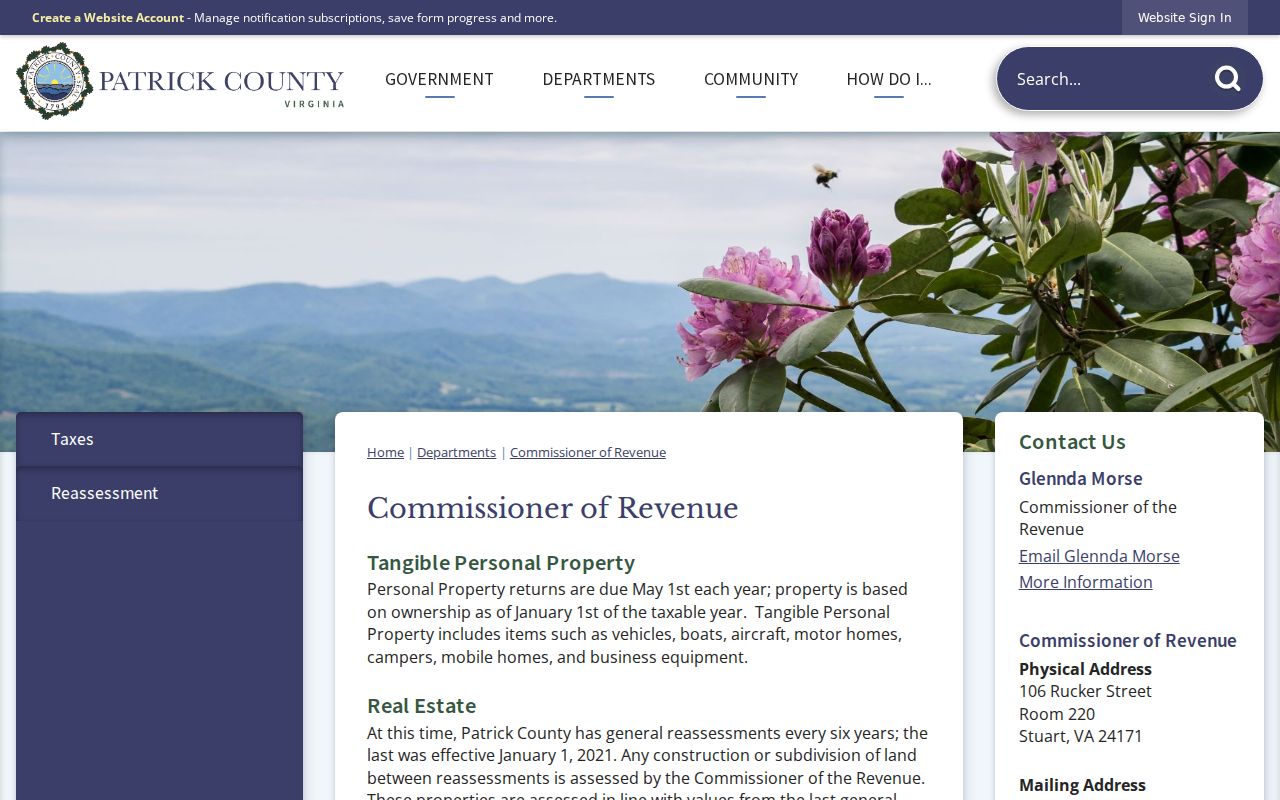
Patrick County offers tax relief for some owners. The Commissioner of the Revenue's page describes the program for eligible elderly or disabled residents. March 1 is the annual application date. The county's page does not spell out the current income, asset, age, disability, or household rules. Confirm those details with the Commissioner first. Applying for relief is not the same as contesting a valuation.
The assessment office sits in Room 220 at 106 Rucker Street in Stuart. Weekday hours run 8 a.m. to 5 p.m. Ask which year's form applies and which documents the office requires. Also ask whether a prior approval needs renewal.
Relief changes the tax burden under the program's rules. It does not automatically change the parcel's market value or property description. Keep the relief application and the assessment notice separate. Each question belongs with a different office. See the Patrick County Commissioner of Revenue page for assessment and relief contacts.
Reviewing a Patrick Assessment Notice
Patrick County's 2027 reassessment page lays out a sequence for valuation questions. Start with the property facts. Discuss any error with the Commissioner's office. The Board of Equalization reviews next. A court route follows. The page posts no deadline table. Read the current reassessment notice for that cycle's filing dates.
Build any review file around the subject parcel. Compare the land-book description, acreage, tax-map number, and improvement status against the notice. The county's process rests on a sales study and a field review. Bring evidence on the value or the physical facts, not a map screenshot, because a GIS outline is not a value study and proves no legal acreage.
Keep the notice. A 2027 reassessment notice reports value information. The Board of Supervisors sets the tax rate during the 2027 budget process, so the notice is not the final tax bill.
Patrick County's own webpage governs the current cycle. It carries the process and dates that apply now. A Library of Virginia volume of Board of Review records covers 1915 through 1926, but those historical assessment records are not the modern appeal channel.
Patrick Values Separate Land and Buildings
Patrick County assesses land and improvements at fair market value under its general standard. The appraisal-card specification describes what the record holds. It includes a land-book description, acreage, tax-map number, owner name and address, and a notation on whether improvements exist. The county publishes no live public card. A parcel screen may show fields beyond that list. The specification still helps. It names the cross-references an owner can ask the office to check.
The Commissioner handles new construction between general reassessments. Values align to the last general reassessment. The county bases new construction on percentage complete on January 1. That snapshot matters when a building is unfinished on the tax date or an improvement appears after a cycle.
A permit and an assessment entry differ. The permit records an approval; the assessment concerns the tax record and value. Ask Building Inspections about a permit mismatch and the Commissioner about the appraisal facts.
Patrick Classifies Manufactured Homes by Type
Patrick County's reassessment material estimates about 2,000 manufactured homes countywide. The classification depends on type. Singlewide homes generally stay personal property until converted. Doublewide homes are assessed as real estate. That distinction decides which record track holds the item. A real-estate parcel search will not answer a personal-property bill question. A mobile-home tax entry is not proof of owning the land beneath it.
The Treasurer collects mobile-home taxes with other county revenue. The Commissioner handles real-estate assessment. When a property includes a manufactured home, confirm the classification and account type with the right office. Have the parcel number, owner name, and bill number ready if available. These are countywide descriptions, and the county publishes no parcel-by-parcel classification list in its static pages.
Patrick Assessment and Tax Bill Are Different
An assessment is a valuation record. A bill applies the tax rate to the taxable value and accounts for the amounts due. A receipt shows payment. A delinquency notice concerns an unpaid balance or collection step. Combining them into one number can hide the reason an amount changed. Compare tax years and parcel identity whenever a bill appears to conflict with an assessment.
The county says recorded instruments as of January 1 control the tax roll. If a deed was filed after that date, the ownership roll may not reflect it in the current year. A transfer does not by itself change the rate schedule or create a payment receipt. The Treasurer is the source for an amount owed; the Clerk is the source for a recorded instrument.
For a deeper explanation of assessed, market, and last-sale figures, use the separate Patrick County property value guide. This page focuses on the tax record and bill path.
Patrick Has No Confirmed Public Bill Search
The Treasurer's public page covers how to pay and which numbers the processor needs. It publishes no public bill-search interface and no delinquent-parcel list. ACI payment access is not a searchable tax account. Start with the full bill number if you have it. Otherwise contact the Treasurer. Ask which parcel or owner details identify the right account.
Need a bill copy, payment history, or tax status the official instructions do not show? Make a focused request to the Treasurer. Virginia FOIA generally requires a response within five working days. Seven more days are available when production is impracticable. A public body may charge reasonable actual costs for search and copying. Do not assume an assessor page exposes a tax balance.
Patrick County tax records answer different questions through different custodians. The Commissioner handles valuation, annual relief, and reassessment review. The Treasurer handles bills, receipts, and collection. Give both offices the parcel description and tax-map number so they discuss the same land.